
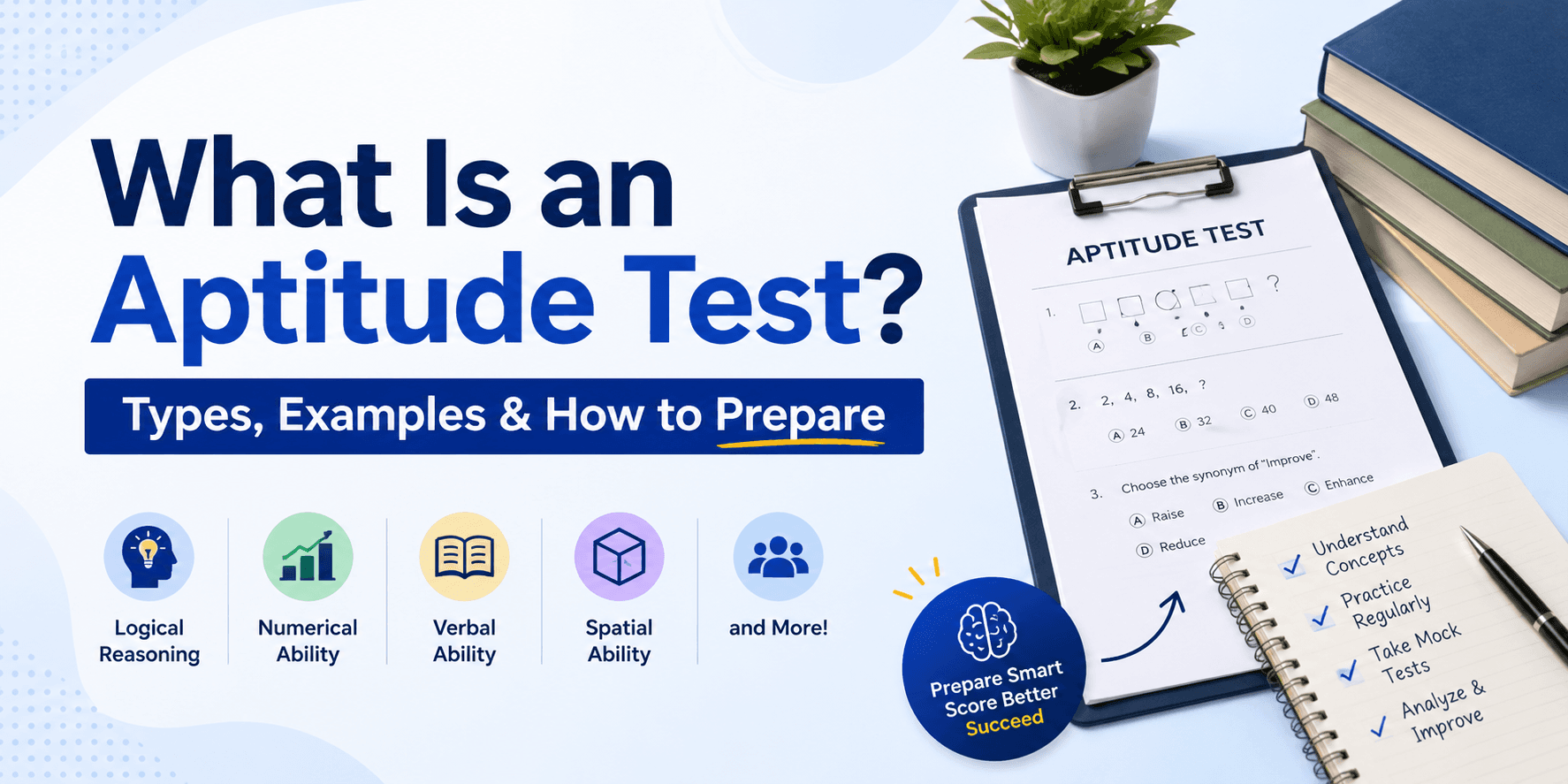
What Is an Aptitude Test?
An aptitude test is a standardized assessment used to measure a person's natural ability to reason, solve problems, and think logically, rather than testing memorized knowledge. Employers, universities, and entrance exam boards use aptitude tests to evaluate how well a candidate can process information, work with numbers, understand language, and make decisions under pressure. Unlike subject-based exams, aptitude tests focus on skills such as verbal reasoning, quantitative reasoning, logical reasoning, and situational judgement.
🔗 Start Practicing Aptitude QuestionsWhy Aptitude Tests Matter
Aptitude tests are widely used in job recruitment, university admissions, and competitive entrance exams because they predict performance more reliably than qualifications alone. Since these tests measure how you think rather than what you have memorized, strong preparation and consistent practice can significantly improve your score.
- Used by top companies during recruitment screening
- Required for MBA, CMAT, and other entrance exams
- Tests problem-solving speed and accuracy
- Predicts on-the-job decision-making ability
- Can be improved significantly with regular practice
Types of Aptitude Tests
Aptitude tests generally fall into a few core categories, each measuring a different mental skill. Most entrance exams and job assessments combine two or more of these types into a single test.
1. Quantitative Aptitude
Quantitative aptitude measures numerical ability, including arithmetic, percentages, ratios, profit and loss, and data interpretation. It is one of the most heavily weighted sections in most aptitude and entrance exams.
🔗 Practice Quantitative Aptitude2. Verbal Reasoning
Verbal reasoning tests your ability to understand written information, identify relationships between words, and draw logical conclusions from passages and statements.
🔗 Practice Verbal Reasoning3. Verbal Ability
Verbal ability focuses on grammar, vocabulary, sentence correction, synonyms, antonyms, and comprehension, testing your command over the English language.
🔗 Practice Verbal Ability4. Logical Reasoning
Logical reasoning evaluates your ability to identify patterns, sequences, and relationships using puzzles, series, coding-decoding, and analogies.
🔗 Practice Logical Reasoning5. Logical Reasoning II (Advanced)
Logical Reasoning II covers advanced pattern recognition topics such as syllogisms, critical reasoning, statement-assumption questions, and complex puzzles often seen in higher-difficulty entrance exams.
🔗 Practice Advanced Logical Reasoning6. Situational Judgement
Situational Judgement Tests (SJTs) present realistic workplace or academic scenarios and ask you to choose the most appropriate response, measuring decision-making, integrity, and interpersonal skills rather than technical knowledge.
🔗 Practice Situational JudgementReal-World Examples of Aptitude Questions
Below are simplified examples of the kind of questions you can expect across common aptitude categories.
- Quantitative: If the price of an item increases by 20% and then decreases by 20%, what is the net change?
- Verbal Reasoning: Identify the word that does not belong in the group: Apple, Banana, Carrot, Mango.
- Logical Reasoning: Find the next number in the series: 2, 6, 12, 20, 30, ?
- Verbal Ability: Choose the correct synonym for 'Abundant'.
- Situational Judgement: A colleague takes credit for your work in a meeting. What is the most appropriate response?
Step-by-Step Methods to Solve Aptitude Questions
A structured approach helps you solve aptitude questions faster and more accurately, especially under timed exam conditions.
- Read the question twice to understand exactly what is being asked
- Identify the category (quantitative, verbal, logical, or situational)
- Eliminate obviously incorrect options first
- Use shortcut formulas for quantitative and logical questions
- For situational judgement, choose the response that balances professionalism and problem-solving
- Double-check calculations before finalizing your answer
- Track your time per question to avoid getting stuck
Common Mistakes to Avoid
- Spending too much time on a single difficult question
- Ignoring negative marking rules and guessing randomly
- Ignoring passage context in verbal reasoning questions
- Not practicing enough timed mock tests before the real exam
- Overlooking simple calculation errors under time pressure
- Choosing the 'ideal' answer instead of the most realistic one in situational judgement tests
Quick Practice Quiz
Test yourself with these five quick questions covering the main aptitude categories. Try to solve each one in under 60 seconds before checking the answer.
- 1. Quantitative: A shopkeeper sells an item for Rs. 1200 at a 20% profit. What was the cost price? (Answer: Rs. 1000)
- 2. Verbal Reasoning: Complete the analogy — Doctor is to Hospital as Teacher is to ____? (Answer: School)
- 3. Logical Reasoning: What comes next in the series 3, 9, 27, 81, ?? (Answer: 243)
- 4. Verbal Ability: Choose the correct antonym for 'Scarce'. (Answer: Abundant)
- 5. Situational Judgement: You disagree with a decision made by your manager during a project. What is the best first step? (Answer: Politely share your concern with supporting reasons in a private conversation)
Want more? This is just a preview. Get 100+ topic-wise questions with detailed explanations and full mock tests on Kuriloo.
🔗 Take the Full Aptitude Practice QuizHow to Prepare for an Aptitude Test
Consistent, structured practice is the most effective way to improve your aptitude test score, whether you are preparing for a job assessment or an entrance exam like CMAT.
- Practice a mix of quantitative, verbal, and logical questions daily
- Take full-length timed mock tests weekly
- Review mistakes and maintain a weak-topic tracker
- Learn shortcut techniques for calculation-heavy questions
- Practice situational judgement scenarios to build decision-making instinct
- Gradually increase question difficulty as your accuracy improves
Practice Aptitude Questions on Kuriloo
Kuriloo offers a complete aptitude practice library covering quantitative aptitude, verbal reasoning, verbal ability, logical reasoning, advanced logical reasoning, and situational judgement, with detailed explanations for every question.
🔗 Explore the Full Aptitude Practice Hub